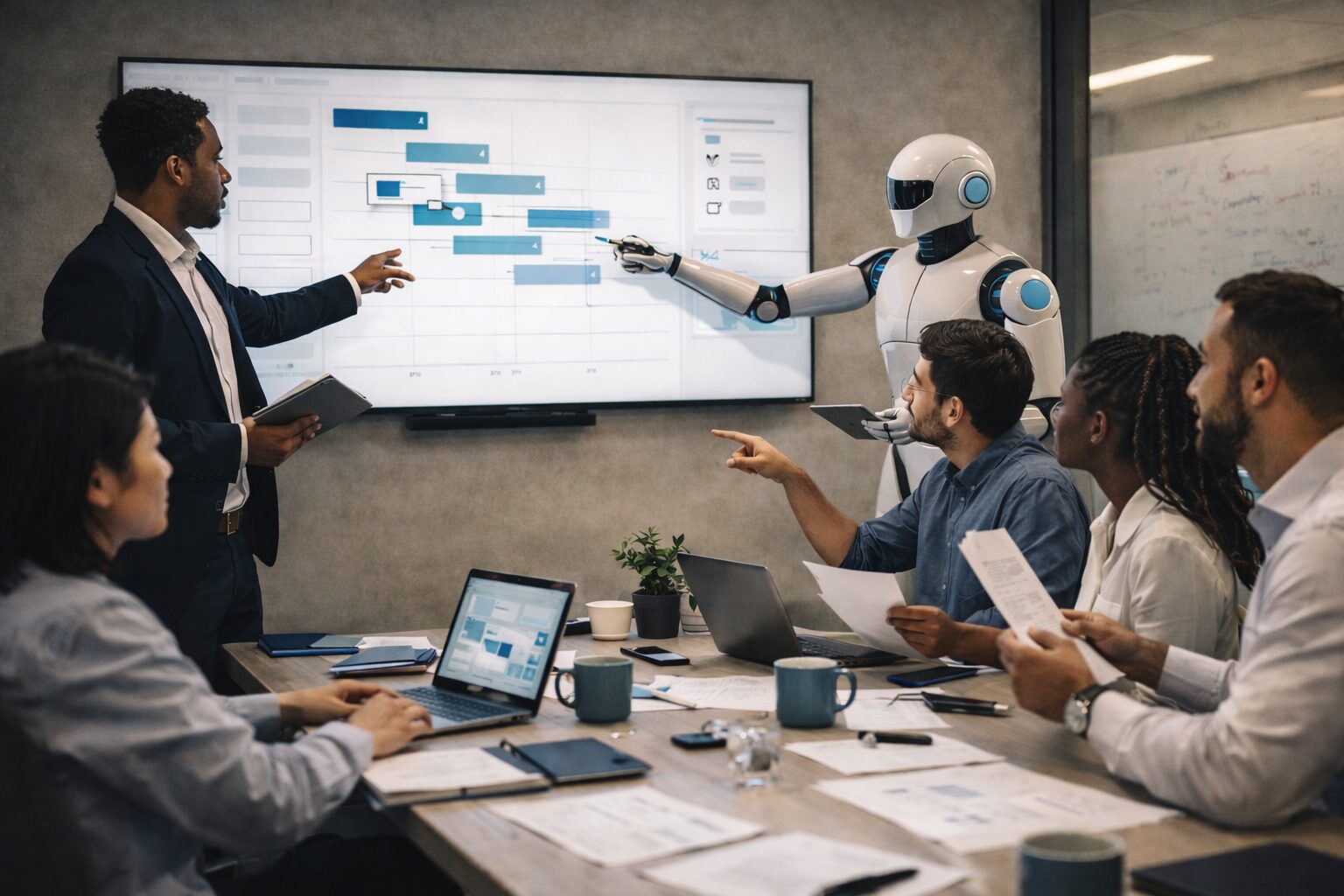
What are the skillsets project managers need in an AI-driven world?
We’re walking into a work world that’s splitting into two lanes.
One lane is deterministic work. You know the inputs. The steps are repeatable. The output is predictable. It’s the “assembly line” side of knowledge work.
The other lane is non-deterministic work. Information is incomplete. Constraints keep moving. People keep redefining what “done” means. Outcomes only make sense after you’ve lived through them. This lane feels less like an assembly line and more like weather.
AI is going to get very good, very fast, at the first lane.
Scheduling, forecasting, reporting, dependency mapping, variance analysis, risk logs, status narratives that follow a template. If it looks like a clean pipeline when you lay it out in a framework, AI can help run it… and eventually run most of it.
Here’s the uncomfortable part: a huge chunk of what we credential and reward in project management lives in the deterministic lane. And AI is turning that lane into a commodity.
Meanwhile, the highest-stakes work is drifting toward the non-deterministic lane. The stuff where judgment, negotiation, prioritization, and sensemaking decide whether the project lives or dies.
Our measurement systems were built for the left lane.
Value is increasingly created on the right.
Project management sits at the fault line.
On paper, project management looks deterministic:
Plans. Schedules. Budgets. Status reports. RAID logs. Milestones. Critical paths.
In practice, the real job is non-deterministic almost all the time.
Requirements arrive half-formed. Stakeholders disagree about what “success” even means. Dependencies shift because priorities shift. Tradeoffs are constant because constraints are constantly renegotiated.
A PM isn’t rewarded for following the plan.
A PM is rewarded for navigating reality when the plan breaks, then rebuilding alignment fast enough to keep the work moving.
That’s why project management is a proving ground for an AI-driven world. PM work sits right at the boundary between:
-
Process (what can be automated)
-
Judgment (what still needs a human to carry responsibility)
The credential problem nobody wants to say out loud.
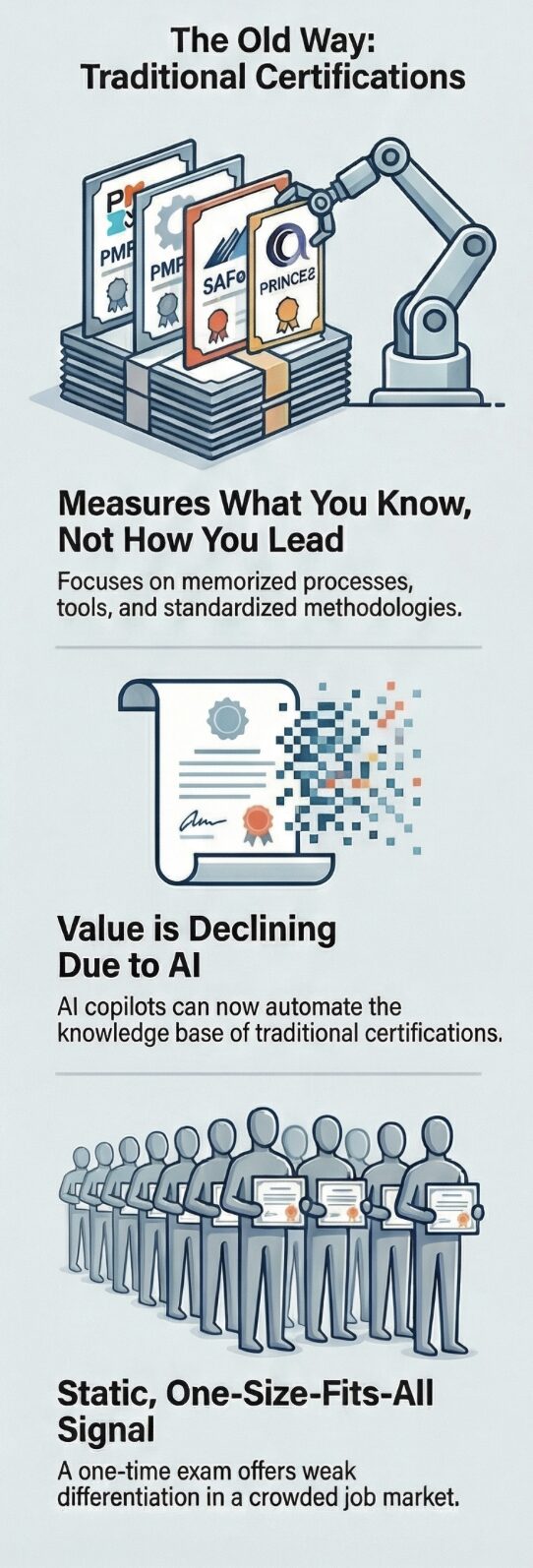
Look at most certifications and degrees in the PM ecosystem. They’re designed to validate process knowledge:
Frameworks, terminology, mechanics, and your ability to recall and apply standardized methods.
That knowledge still matters. It’s just no longer rare.
When “how to build a plan” is embedded in copilots trained on the same bodies of knowledge, process mastery stops being a differentiator. And when everyone can generate a polished plan in minutes, the plan itself becomes less of a signal.
There’s another issue hiding underneath: credentials are usually static validations. They certify a moment in time.
- They don’t certify how you adapt.
- They don’t certify how you interpret ambiguity.
- They don’t certify how you make tradeoffs when everyone’s mad.
So we end up with a market full of professionals who can speak the language of delivery… but whose real capability only shows up when things get messy.
That’s the shift we’re in:
From valuing memorized process
To needing a way to describe how a person actually operates under uncertainty.
Why a lot of upskill advice misses the point.
The default prescription right now is predictable:
Learn more tools. Stack more certifications. Get fluent in prompts. Become the “AI PM.”
Some of that is fine. But most of it is still chasing the deterministic lane.
The real opportunity is in the non-deterministic lane. And the requirement there isn’t more knowledge.
It’s more self-clarity.
In an AI-driven world, your advantage is less about what you know and more about how you lead when the answer isn’t obvious.
That “how” isn’t just hyperbole. It’s patterned. It’s repeatable. It’s observable.
And if you can’t name your pattern, you can’t direct it.
That’s the heart of “Before AI learns us, we must learn ourselves.” The goal isn’t to become a better template-filler. The goal is to become a more reliable decision-maker, trust-builder, and integrator when the work turns non-deterministic.
A practical way to name how you operate: The Signature Intelligence Model
This is what the Signature Intelligence Model (SIM) is built for.
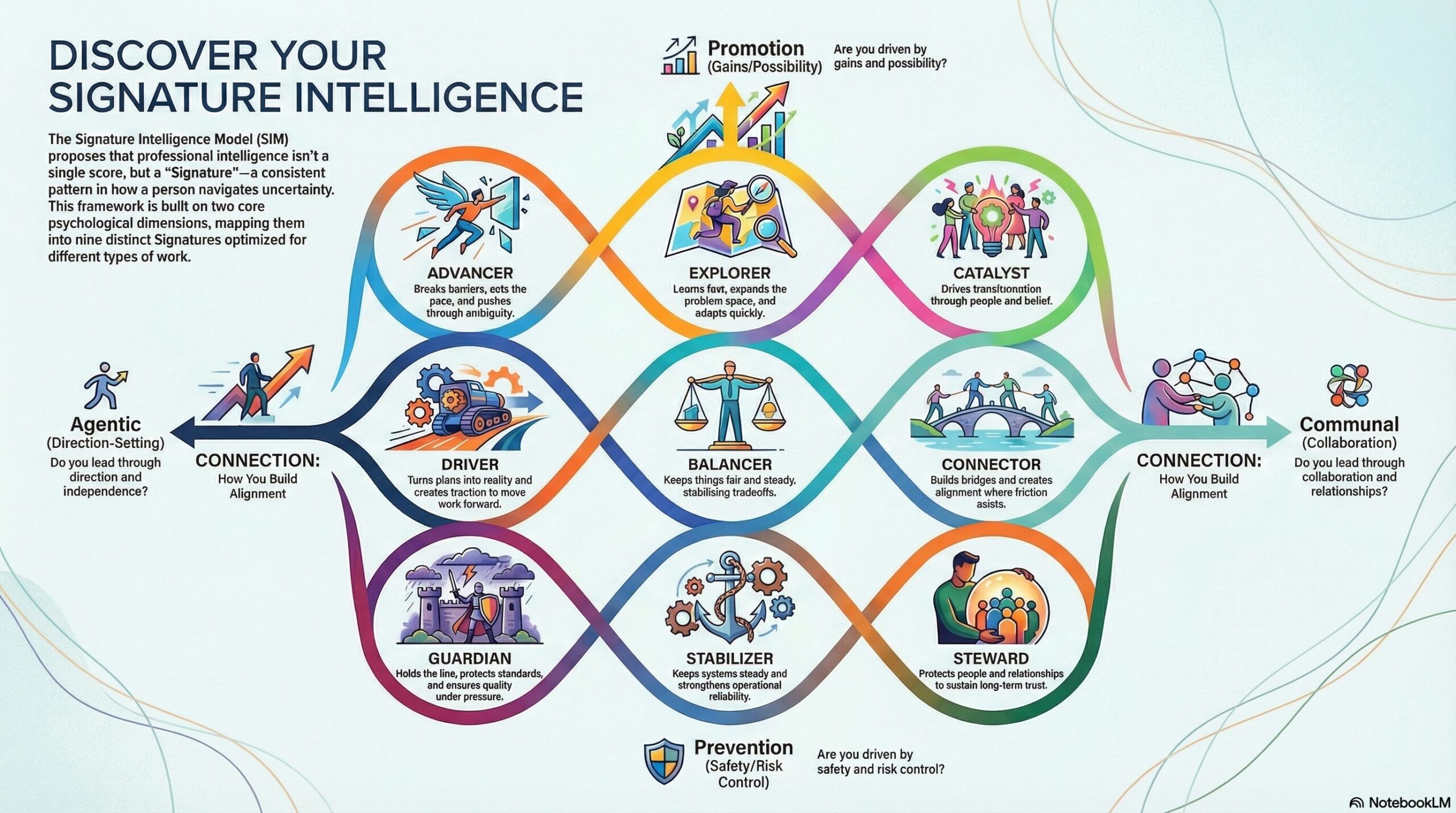
SIM starts with a simple claim: intelligence isn’t one score. It’s a signature, meaning a consistent pattern in how a person navigates uncertainty.
It’s grounded in long-running psychological research that points to two big forces shaping behavior:
1) Motivation
Based on Regulatory Focus Theory, people tend to lean toward:
- Promotion: gains, progress, possibility, moving toward a better future
- Prevention: safety, obligations, risk control, protecting what matters
2) Connection
Based on agency-communion theory, people tend to build alignment through:
- Agentic: direction-setting, independence, decisiveness
- Communal: collaboration, relationships, cohesion
SIM combines these two axes into nine (9) signatures. Each one is optimized for different kinds of uncertainty.
Not “good” or “bad.”
Just different tools for different terrain.
The nine signatures, in plain language
Two frames that keep SIM from becoming a personality-label game.
People aren’t static. Context matters. Stress matters. Stakes matter.
SIM adds two concepts to reflect that:
Tilts
A Tilt is your secondary lean, the adjacent influence that shifts how your signature shows up.
- Example 1: A Driver with a Guardian Tilt becomes a principled executor who tightens scope and raises standards.
- Example 2: A Driver with an Explorer Tilt becomes a more experimental executor who tests and iterates.
Modes
A Mode is how your signature expresses itself in the moment:
- Analytical: reflection and evaluation
- Expressive: action and interaction
- Adaptive: shifting fluidly between the two
That’s real life. People flex.
Where signature shows up in project management.
Once you understand your signature, you start to see why project management has never been just about plans.
Signature shows up in:
- how you handle politics without calling it politics
- what you escalate vs what you tolerate
- what you frame as a risk vs what you frame as an opportunity
- how you interpret stakeholder silence
- how you respond to executive ambiguity
- how you decide whether conflict is a problem to solve or a truth to surface
No certification can tell you that.
No PPM tool can solve it for you.
That’s not a data problem. It’s a judgment problem.
And it becomes more important, not less, as AI takes deterministic pieces off your plate.
Nine micro-scenarios: what non-deterministic leadership looks like
-
Advancer – A program is stuck in analysis paralysis. The Advancer calls the decision, defines a minimum viable direction, and forces a time-boxed commitment. Not because certainty exists, but because progress creates clarity.
-
Explorer – Requirements are contradictory and the sponsor keeps changing their mind. The Explorer reframes the problem, runs short discovery loops, and surfaces patterns in what stakeholders actually value, not just what they request in meetings.
-
Catalyst – A transformation effort has quiet resistance. The Catalyst names the emotional reality, builds a coalition of believers, and turns a skeptical room into a shared narrative people can move behind.
-
Driver – A cross-team dependency keeps slipping because nobody owns the handoff. The Driver clarifies ownership, defines a tight execution path, and resets expectations with crisp follow-through.
-
Balancer – Two executives are pulling the roadmap in opposite directions. The Balancer creates a fair tradeoff frame, makes constraints visible, and lands a decision that doesn’t feel like a win-lose story.
-
Connector – A project is “on track” but the teams quietly don’t trust each other. The Connector surfaces misalignment early, builds shared language, and prevents a late-stage failure that would have been blamed on “delivery.”
-
Guardian – A shortcut would hit the deadline but violate a control or compromise quality. The Guardian holds the line, escalates with evidence, and protects the organization from a future incident everyone would later pretend was unforeseeable.
-
Stabilizer – A migration is creating operational volatility. The Stabilizer sets stabilization gates, strengthens monitoring and rollback plans, and keeps the system reliable while change is still happening.
-
Steward – A reorg is creating attrition risk and stakeholder fatigue. The Steward protects relationships, preserves continuity, and keeps delivery humane enough that people stay engaged long enough to finish the work.
Those are the moments that determine outcomes.
Not the Gantt chart.
Not the template.
Not the acronym list in someone’s email signature.
Using SIM across the PM career lifecycle
SIM doesn’t stop at “how you lead during delivery.” It can map the whole project management career lifecycle with signature-specific guidance.
Here are eight high-value opportunities where SIM can be applied immediately:
-
Exploration and role search- Identify project types and environments where your signature naturally thrives, instead of forcing fit through brute effort.
-
Recruitment and selection – Hire for operator intelligence, not just credentials, by matching signatures to the uncertainty the role actually faces.
-
Onboarding and integration – Accelerate ramp-up by tailoring onboarding to how someone learns, decides, and aligns with others.
-
Performance and development – Coach the right skills for the right signature (scope control for Advancers, focus and discipline for Explorers, openness to change for Guardians, and so on).
-
Growth and mobility – Plan progression paths that align with signature strengths, not generic career ladders.
-
Transition and offboarding – Capture lessons learned as reasoning and judgment patterns, not just outcomes, so organizations keep the intelligence that produced results.
-
Team composition and portfolio staffing – Build balanced teams intentionally. Too many Promotion-leaning profiles can fuel scope creep. Too many Prevention-leaning profiles can slow momentum. SIM gives leaders a way to see this and correct it.
-
Leading blended human-AI teams – As AI becomes a real “team member,” the PM mandate shifts toward integration and governance. The question stops being “Who knows the process?” and becomes “Who will manage the AI, its outputs, and the trust around it?”
The point of the title
Before AI learns us, meaning before systems can infer our habits and default moves by watching what we do, we need to learn ourselves so we can lead with intention instead of inertia.
AI will manage more of the process. That’s coming.
The question is whether project managers treat that as displacement, or as a chance to step into the real center of the profession: judgment under uncertainty, alignment under pressure, and responsibility for consequences.
Next time an AI-generated plan looks “good enough,” pause and ask: what part of this still belongs to me?
That’s where the profession is headed.