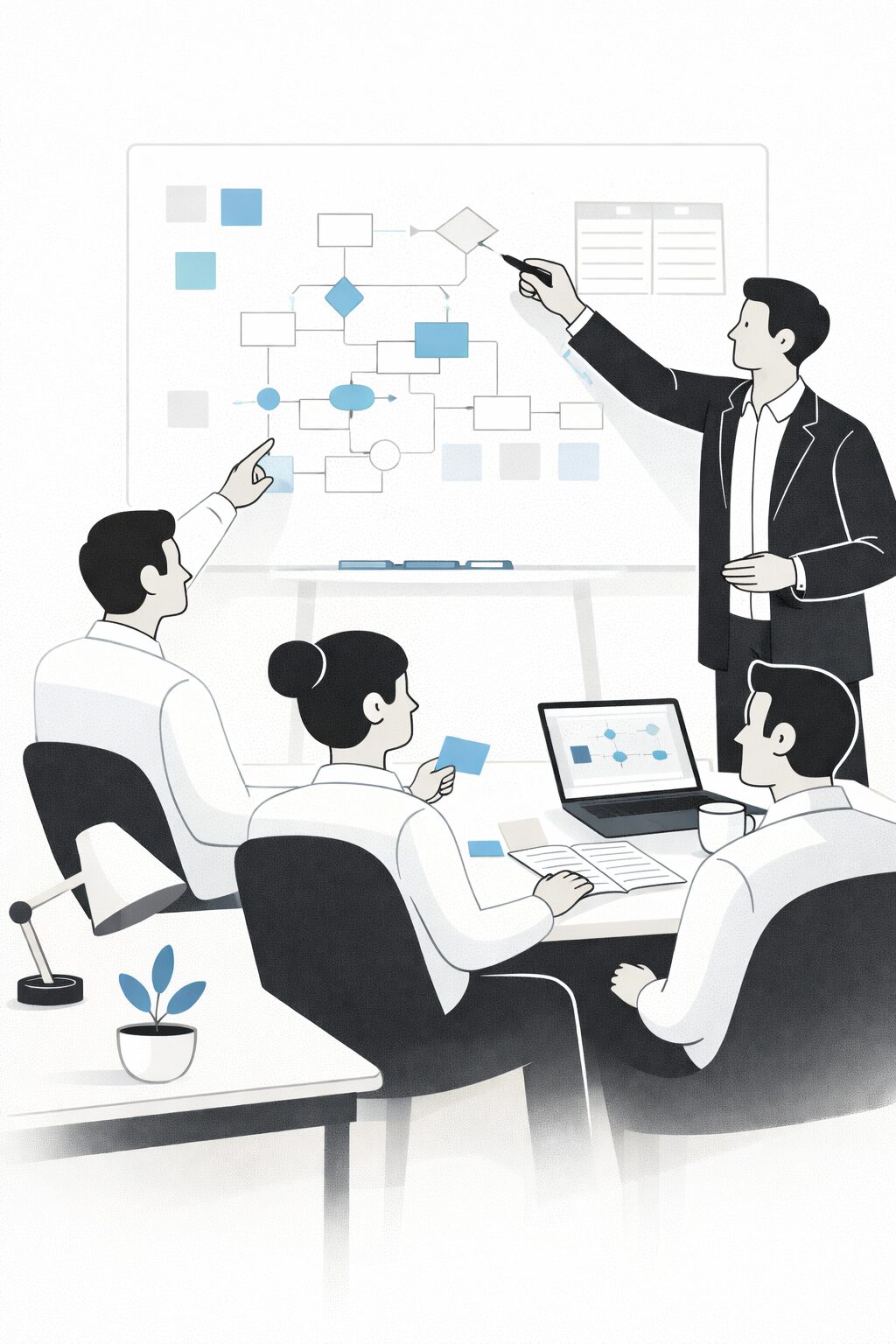
When the dashboard isn’t the job anymore.
Maya’s a data analyst at a small marketing firm. Last year, her mornings started with the grind: pulling campaign data, cleaning it, building dashboards, and writing up what happened so the account team could talk to clients like they had a handle on things. Now most of that shows up automatically. The dashboards refresh in real time. The AI summarizes performance, flags anomalies, drafts insights, even suggests a budget reallocation. Intelligence is cheap, fast, and always on… like turning on a light switch.
Then comes the client call. The client doesn’t ask, “Do we have the numbers?” They already do. Everyone does. What they ask is, “Should we cut spend on this channel?” “Do we change the messaging?” “Do we lean into growth even if refunds go up for a month?” Even if the AI gives Maya the single best recommendation based on patterns and probability, the thing that’s still sitting on her desk is the decision. And the consequence. A wrong call can burn a small business’s runway, erode customer trust, trigger churn, or put Maya’s own team under pressure. The data got easier. The responsibility got heavier.
That’s the architecture shift in the future of work. For decades, knowledge work revolved around deterministic labor: gather information, analyze it, package it, repeat. We perfected it, built jobs and ladders around it. AI is now commoditizing that layer. It doesn’t eliminate the work, it moves the center of gravity. What remains, and what becomes more valuable, is non-deterministic work: choosing priorities, weighing tradeoffs, managing risk, and making a call when there isn’t one “correct” answer. The more AI can generate ten plausible paths in seconds, the more the human job becomes picking one path on purpose… and owning what it optimizes and what it sacrifices.
So what do we do in a world like this? We stop trying to beat AI at analysis and start getting disciplined about judgment. The new advantage is not having information. It’s having a clear way to frame decisions, especially when they carry moral weight and real consequences for other people. That means being able to answer questions like: What are we optimizing for? What are we willing to risk? What do we refuse to trade away, even if it boosts results?
That’s where the Signature Intelligence Model (SIM) fits, cleanly. SIM is a practical model for decision-making and alignment in the non-deterministic zone. It maps two forces that shape how you make calls: how you pursue outcomes (do you naturally push toward growth and gains, protect against risk and loss, or flex between both) and how you connect with others while deciding (do you drive independently, collaborate relationally, or flex). In Maya’s world, SIM doesn’t replace AI’s recommendations. It helps her interpret them, challenge them, and choose responsibly… by making her default decision posture visible, exposing her blind spots under pressure, and helping her partner with people who balance what she naturally leans toward. In the age of abundant intelligence, SIM becomes a compass for the scarce part of work: making the decision.
When Your Instincts Show Up Before Your Logic.
After that client call, Maya doesn’t just feel pressure. She feels exposed. The “numbers person” used to be the hero because getting clean insight was hard. Now the insight is on tap. So when the room turns to her and says, “Alright… what should we do?” she can feel her instincts kick in before her logic even finishes loading. She gets impatient when the team wants to debate for forty minutes. Or she gets tight in her chest when someone wants to “move fast” on a recommendation that could burn the client’s budget. Or she keeps circling back to trust, because if the firm makes a call that feels manipulative, the brand might win the week and lose the year. None of this is irrational. It’s her decision posture showing itself.
That’s why SIM clicks emotionally. It explains the stuff you already feel but haven’t had clean words for. In the new architecture of work, conflict isn’t mostly about who has the data. It’s about what you think the data should be used for. Speed vs. certainty. Growth vs. protection. Performance vs. trust. And when people disagree, it can start to feel personal… like someone’s being reckless, or stubborn, or overly cautious, or “too soft.” SIM reframes that. Those aren’t character flaws. They’re signals about what each person is optimizing for.
If you’ve ever left a meeting thinking, “Why is this so hard when the answer is right there?” SIM gives you a better next thought: “What am I optimizing for right now, and what are they optimizing for?” Because that’s the hard question in an AI-shaped workplace. Not “Do we know enough?” We usually do. The hard question is “Which consequence are we willing to carry?” SIM helps you see your default pattern, name it without judgment, and work with others more intentionally so decisions don’t become a tug-of-war disguised as collaboration.
Maya starts noticing something a little unsettling in herself.
Not because she’s confused. She’s not. AI is keeping the numbers clean, fresh, and constantly updated. The unsettling part is this: when the “answer” is always available, the room stops rewarding who found the insight and starts rewarding who can carry the decision. That’s when her instincts get louder. She feels herself leaning into speed, or into caution, or into trust-building, depending on the day and the stakes. And she realizes the new problem is not access to intelligence. It’s knowing what she’s optimizing for, how she’s influencing others, and whether her default approach is helping or quietly biasing the call.
So the practical need becomes obvious: she needs a repeatable way to name how she makes decisions and how she creates alignment, especially in messy moments. That’s what SIM gives her.
How SIM works
Motivation
Motivation is about how you pursue outcomes. SIM draws this axis from Regulatory Focus Theory, which distinguishes between a promotion focus (advancement, achievement, gains) and a prevention focus (safety, responsibility, avoiding losses).
In Maya’s world, this shows up as a very specific internal question: “What does success mean right now?”
-
Promotion: you’re pulled toward upside, growth, progress
-
Prevention: you’re pulled toward protecting against downside, risk, failure
-
Balanced: you’re pulled toward the tradeoff itself, getting the right mix for today’s stakes
Connection
Connection is about how you align with other humans while moving work forward. SIM builds on the agency and communion framework, which treats agency (asserting direction, competence, independence) and communion (trust, cooperation, relationship) as two fundamental orientations in social life and social judgment.
This matters because decisions don’t just need to be “right.” They need to be adopted.
-
Agentic: you drive clarity and direction, quickly
-
Communal: you build buy-in and trust so the decision holds
-
Balanced: you flex between drive and trust based on the moment
The Nine Signatures
Cross Motivation (promotion / balanced / prevention) with Connection (agentic / balanced / communal) and you get a 3×3 grid with nine Signatures. The grid is a practical move: it turns two continuous dimensions into something usable in real conversations and real decisions.
For Maya, a natural fit is Explorer (Promotion × Balanced). She’s oriented toward progress and learning, but she can stay collaborative and grounded enough to make the decision land.
-
Promotion
-
Advancer (Promotion × Agentic): breaks barriers, sets pace
-
Explorer (Promotion × Balanced): learns fast, adapts quickly
-
Catalyst (Promotion × Communal): creates momentum through people
-
-
Balanced
-
Driver (Balanced × Agentic): executes, converts decisions into delivery
-
Balancer (Balanced × Balanced): pressure-tests tradeoffs, stabilizes direction
-
Connector (Balanced × Communal): builds trust and shared understanding
-
-
Prevention
-
Guardian (Prevention × Agentic): protects standards, enforces guardrails
-
Stabilizer (Prevention × Balanced): manages risk calmly, prevents whiplash
-
Steward (Prevention × Communal): protects people and long-term trust
-
Tilt
Here’s where SIM stops feeling like a neat diagram and starts feeling like real life.
People have stable tendencies, and they also show predictable shifts across situations. That “if this situation, then that response” pattern is a core idea in person-situation research, and it shows up in work settings where cues activate different behaviors.
Tilt is SIM’s way of capturing that you may lean into a neighboring Signature when the context changes.
For Maya, Explorer might be her baseline. But when the client’s runway is tight and the consequences are sharp, she may tilt toward Stabilizer. She slows down, checks assumptions, and optimizes for not doing harm.
-
What triggers Tilt: stakes, time pressure, uncertainty, audience, scrutiny
-
What Tilt helps you catch: “I’m leaning hard into growth” or “I’m locking into protection”
-
What Tilt lets you do: adjust your approach, or deliberately pull in a complementary posture before the decision is made
Modes
Even within a Signature, how you show up can vary day to day. Research on within-person variability supports the idea that people move through different states while still having stable central tendencies over time.
SIM captures that with Modes, meaning how your Signature expresses in action.
For Maya, Explorer can look different depending on what the moment needs. If the room is anxious, she may need to be more expressive. If the room is scattered, she may need to be more analytical. If the room is split, she may need to be adaptive and switch deliberately.
-
Expressive mode: energetic, communicative, persuasive
-
Analytical mode: structured, precise, detail-driven
-
Adaptive mode: flexible, situational, resourceful
What you get from SIM
This is the payoff. SIM helps you become more intentional about the part of work AI can’t carry for you: judgment and alignment.
-
Strengths: what you reliably bring when decisions are real
-
Blind spots under stress: what you tend to overdo when stakes rise
-
Best-fit environments: where your Signature creates outsized value
-
Complementary teammates: who improves your decisions by balancing your default posture
Maya’s quick scan
When the AI output is sitting there and the room turns to her, Maya runs a simple internal checklist.
-
What am I optimizing for right now: growth or protection?
-
How am I moving people: drive or trust?
-
What’s pulling my tilt in this situation?
-
Which mode will make this decision land and hold: expressive, analytical, or adaptive?
Maya’s story is just the cleanest version of what a lot of us are walking into. AI is making the “smart work” cheap… the summaries, the patterns, the first-draft recommendations. Which means the part that’s left, the part you can’t outsource, is the call. The tradeoff. The consequence. And when that weight shifts onto you, your defaults start showing up fast. Maybe you push for speed because you hate stagnation. Maybe you slow everything down because you can see ten ways it can go wrong. Maybe you keep pulling the group toward alignment because you’ve watched “great decisions” die in execution. That’s why it matters to figure out your Signature now. Not for self-awareness as a hobby, but because your Signature is the shape of your judgment… and judgment is becoming the job.
Getting your Signature doesn’t have to be a big production. Think of it like finding your “default settings” before you walk into high-stakes moments. Ask two simple questions: when outcomes are on the line, do you naturally chase upside or protect downside (or do you flex)? And when people need to move together, do you naturally drive direction or build buy-in (or do you flex)? That’s the SIM grid. Once you can name where you tend to land, you can start using it as a tool instead of letting it run silently in the background.
Now the application.
Start by naming your Signature and writing it down somewhere you’ll actually see it this week. One sentence is enough: “I tend to optimize for ___ and I tend to align people by ___.” Then make one deliberate adjustment in how you show up. If you lean toward growth, add one sentence about risk. If you lean toward protection, add one sentence about opportunity. If you lean toward drive, add one sentence that invites ownership from others. If you lean toward trust-building, add one sentence that forces the decision. Tiny moves. Big effect.
Then use SIM like a mirror for one week. A week is short enough to do without overthinking and long enough to reveal patterns you can’t see in the moment. Monday is about noticing, not fixing. In the morning, glance at your calendar and circle one meeting where a decision might be made. In the meeting, pay attention to your first instinct when the conversation gets messy. Do you push forward, slow down, or try to bring everyone together? After the meeting, take two minutes and write one line: “I optimized for ___ and I tried to align by ___.” Monday evening, don’t analyze it. Just collect it.
Tuesday and Wednesday are about testing one small shift. Pick one moment each day and do the opposite of your default by just one notch. If you’re a speed person, pause and ask, “What’s the downside we’re accepting?” If you’re a caution person, ask, “What upside are we missing if we play it safe?” If you tend to drive, ask someone else to name what would make them commit. If you tend to build consensus, close with, “What decision are we making today?” Keep it light. The point is to widen your range without losing yourself.
Thursday is about partnerships. Look back at the week and notice who consistently makes decisions better when they’re in the room. Not who agrees with you… who complements you. The person who naturally pressure-tests your optimism. The person who adds momentum when you’re getting stuck. The person who translates your logic into buy-in. SIM makes this visible, and once you see it, you can design around it instead of hoping it happens by accident.
Friday is about AI, because this is the new operating system for work. Let AI handle the mechanical stuff: summarizing threads, drafting options, spotting patterns, outlining scenarios, turning notes into a first pass. Then keep the non-deterministic work for you: deciding what matters, choosing the tradeoff, and getting humans aligned around the decision. If you do nothing else, adopt one rule: AI can propose, but you own the call. That’s Signature Intelligence in action.
By the end of the week, you’ll have something most people don’t. A clearer read on your default judgment, a couple small upgrades to how you communicate, and a better sense of who you need around you when decisions carry consequences. That’s not soft. That’s how you stay valuable when intelligence becomes abundant.
